When Your Days Run You
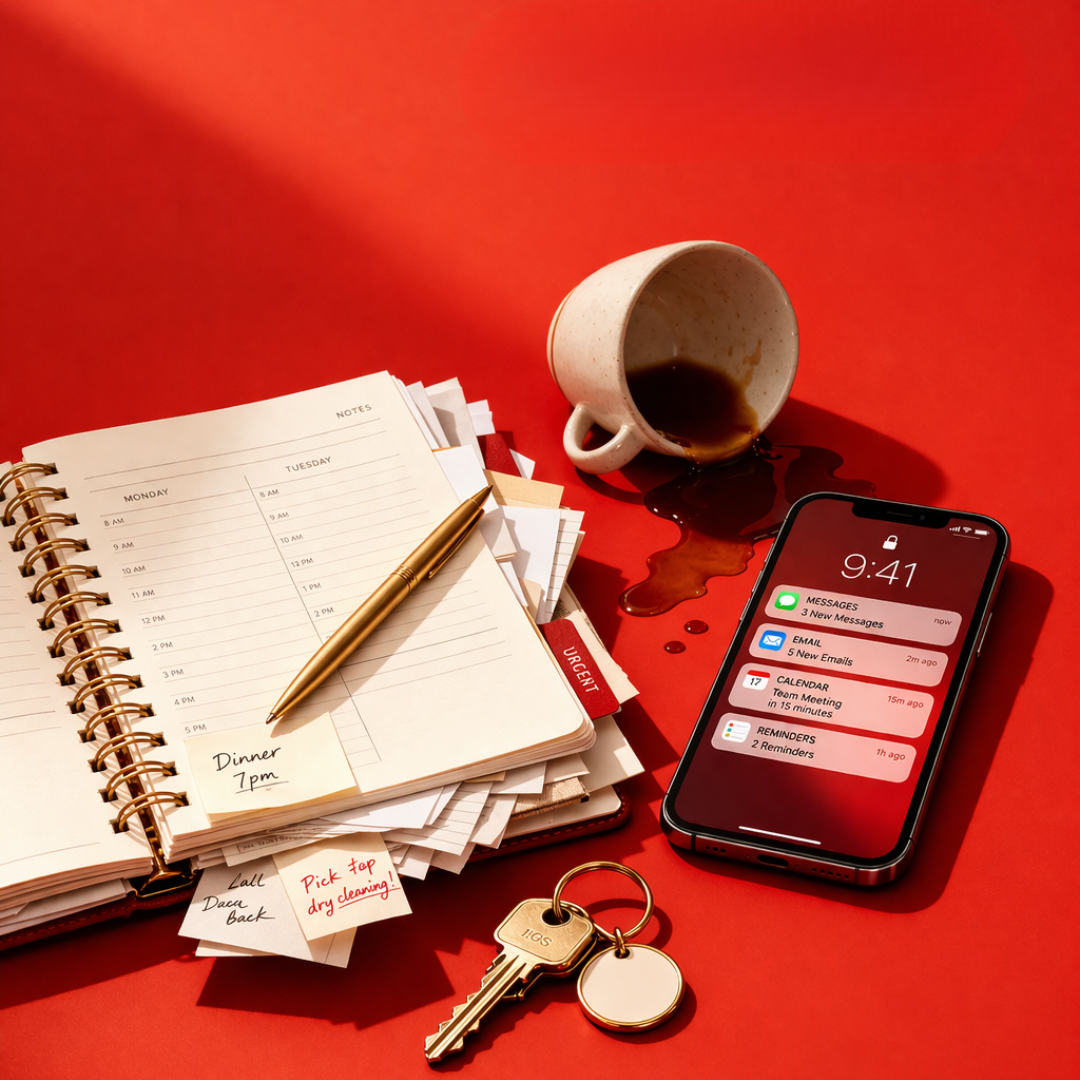
You got to the end of the day. You were busy the whole time. And you still can't say what actually got done. You were responding, solving, showing up, holding things together. For everyone and everything that needed you. The day simply happened.
And the things that actually matter to you got pushed to tomorrow. The thinking you wanted to do. The conversation you kept postponing. The work that needs your creativity and full attention. Once again.
And tomorrow, there won't be more space. There never is.
There's a version of overwhelm that doesn't announce itself. The quiet kind. Where you keep going. Where you function. Where from the outside everything looks fine. But inside, something's running on empty.
You're behind in a way that a productive weekend doesn't solve. You have a sense that something needs to change, but you can't find the moment to sit down and figure it out.
So you keep going. And the longer you keep going, the more normal it starts to feel. The weight becomes the baseline. You stop noticing it's there because it's always been there.
Until something small tips it. A conversation that shouldn't have been hard. A task that shouldn't have taken that long. A moment where you realize you've been running on fumes for longer than you thought.
That's the point where you reach for a new system, a “better” tool or hack. A different way to organize the chaos. But the chaos isn't the problem. What you're carrying is.
And no tool or system will show you that. Another Monday will. Another Monday where it feels the same.
You blocked your calendar, protected your mornings, batched your tasks. And for a while, something shifted.
Then the weeks filled up again. The protected time disappeared. The system quietly stopped working. And the feeling came back, heavier than before, with the added weight of having tried and not succeeded.
Here's what I notice with my clients, again and again. The problem was never the time. It was what the time was being asked to hold.
Roles that accumulated without anyone deciding they should. Expectations nobody ever stopped to question. Responsibilities that arrived one at a time and quietly became permanent.
You’ve probably never had the chance to look at all of it at once. That's just how it goes when the days keep running you.
And a big part of what nobody counts is the time that disappears before the day even starts.
You think the commute takes 30 minutes. It doesn't.
You need to get to the car. Find parking. Walk to your desk. And before any of that, your head is already there. On the meeting, the conversation you're not looking forward to, the thing you didn't finish yesterday.
After work, the same role follows you home. The decompression. The mental tabs that stay open. The recovery you need but rarely give yourself.
That's not 30 minutes. That's easily two hours of your day. Uncounted, unplanned, invisible on any calendar. I call this forgotten time.
Every role in your life has it. Not just work. The mental load of being a parent, a partner, a child with aging parents, the person who holds things together. The preparation, the transitions, the recovery. None of it appears in any schedule. All of it takes up real space.
When you add it up, you realize you've been planning your days on capacity that was never actually there. You were managing time you never actually had.
Which means the first move isn't to change anything. It's to look. Before you can change how your days run, you need to see what they're actually being asked to hold. Not what you think you're carrying. What's actually there.
That means looking at your work roles and your life roles together. The obvious ones and the ones that accumulated quietly. The ones you chose and the ones that simply arrived one day and stayed.
It means accounting for the forgotten time. The transitions, the mental load, the recovery. Everything that doesn't appear in any schedule but takes up real space.
And it means doing that without immediately trying to fix it. Clarity first. Action from there.
Seeing it clearly, all of it, in one place, probably for the first time, is itself a shift. Not because anything has changed yet. Because they finally understand what they're working with.
That's where control starts to come back. Not by doing more. Not by managing better. But by seeing clearly and choosing deliberately.
If this resonates, I created a free reset for exactly this moment.
It's not a productivity tool. It's not a list of hacks. It takes about twenty minutes and it'll show you more about what's actually going on than any system ever has.
The Control Reset: violettakrok.com/the-control-reset
Any questions? Send me a message directly here.